Buildings constructed between 2020 and 2023 were built under conditions unlike anything the industry had seen before: material shortages, forced substitutions, labor gaps, start-and-stop delays, and reduced supervision. Those conditions created defects that are just now showing up as real damage. COVID construction defect litigation is accelerating, and the cases coming down the pipeline in the next two to five years will be some of the most complex construction disputes in a generation. Attorneys and general contractors who understand what happened during those years will be better positioned to handle what’s coming.
Nobody cut corners on purpose.
That is one of the most important things to understand about the COVID construction defect litigation wave building in courtrooms right now. In most of these cases, the people who built these buildings were not being negligent in the traditional sense. They were doing the best they could under conditions that made proper construction nearly impossible. They could not get the right materials. They could not keep the same crews on site. They were under enormous schedule pressure from owners and lenders who had no interest in hearing about supply chain problems.
They substituted. They improvised. They kept building.
And now those buildings are failing.
A Real Case: When the Right Answer Was Not Available
Mark Stewart has been in commercial roofing for more than 30 years. This is a story he tells because it captures exactly how COVID construction defect problems are born.
A wood-structure apartment building needed above-deck rigid insulation. It was in the spec. The system was designed around it. But this was the height of the pandemic, and that insulation was simply not available. If you could find it, the price had escalated so dramatically it was not a realistic option. The project could not wait.
So the designer of record made a call: use batt insulation installed below the deck instead. It was available. It would provide thermal performance. It seemed like a reasonable substitution under the circumstances.
What it actually did was move the dew point.
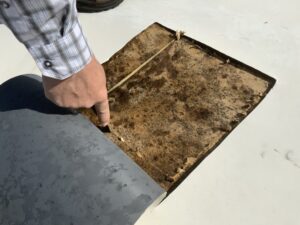
With insulation below the deck rather than above it, the underside of the roof membrane became the cold surface in the assembly. Warm, humid air inside the building hit that cold surface and condensed. Water formed on the underside of the membrane, night after night, season after season. It soaked into the wood framing. Microbial growth spread through the upper floors. By the time anyone understood what was happening, the structural members had to be reinforced, the roof had to be torn off down to the deck, and the entire top floor of the building had to be vacated while repairs were made.
No one was a shyster. No one was trying to cheat anyone. The designer tried to solve an impossible problem with the tools available, and the physics of building science did not care about the circumstances.
That is the story of COVID construction defect litigation in miniature.
What Made the COVID Construction Window Different
The pandemic created a specific combination of conditions that do not normally exist simultaneously. Understanding that combination is essential for anyone handling these cases.
Material shortages forced substitutions across every category of building product. Roofing insulation, sealants, waterproofing membranes, windows, doors, wall substrates: contractors could not get what was specified, so they used what they could find. Some substitutions were engineered and reviewed. Many were not. When a foreman on a job site needs to keep moving, and the specified product has an eight-week lead time, decisions get made quickly, and documentation suffers.
Start-and-stop project delays meant that different crews often began and finished the same systems. The crew that installed the waterproofing membrane may not have been the crew that finished the flashing details. Handoffs between crews are already a known failure point in construction. During COVID, those handoffs multiplied.
Products were exposed to the weather longer than they were designed to handle. A self-adhered air barrier installed in March and not covered until September has been through conditions it was never engineered for. Adhesive degrades. Seams lift. By the time the wall assembly is closed in, no one can see what is happening inside.
Labor shortages meant that less experienced workers were doing work they had not done before. The industry was already facing a skilled trades gap before the pandemic. COVID accelerated that gap dramatically. Workers who had never installed a particular roofing system or waterproofing assembly were installing them, with less supervision than the work required, under schedule pressure that discouraged slowing down to do things right.
Mock-ups were skipped. On a normal project, a mock-up of a critical assembly is built, tested, and approved before full-scale installation begins. During COVID, mock-ups were among the first things cut when schedules compressed. Defective installation details got replicated across entire buildings with no quality checkpoint in place.
Why the Cases Are Just Now Appearing
Construction defects do not always announce themselves immediately. A roof that was improperly installed in 2021 may not produce a visible leak for two or three years, especially if conditions have to align in a specific way: the right storm, the right temperature differential, the right amount of accumulated moisture.
Water intrusion that starts small works its way into framing, insulation, and interior assemblies over time before anyone notices. Microbial growth takes months to establish and more months to become visible or detectable. Structural damage from long-term moisture exposure can take years to manifest as anything a building owner can see or feel.
This is exactly why buildings from the COVID construction window, roughly 2020 through 2023, are the source of an increasing number of construction defect cases right now. The defects were built in four and five years ago. They are showing up today.
Jeff Martin puts it directly: “We’re seeing more and more litigation that’s going to happen as a result of those conditions. As time goes by, we’re seeing the long-term effects.”
The Litigation Complexity These Cases Carry
COVID construction defect litigation is not just more common than typical construction cases. It is more complicated.
The chain of accountability is harder to trace. Material substitutions often happened without formal documentation or an engineered review. In some cases, the substitution was a field decision made by a foreman or subcontractor without anyone above them in the chain being aware. Finding the paper trail, or establishing that there is none, requires an expert who understands how construction projects actually operate, not just how they are supposed to operate.
The workforce that installed these systems may no longer be findable. Subcontractor turnover in the construction industry is high under normal circumstances. During COVID, it was extreme. Workers moved between projects, left the industry, or relocated. In some cases, deposing the actual individuals who did the installation is no longer possible.
And because the defects often result from substitutions that seemed reasonable at the time, the standard of care analysis is more nuanced than in a straightforward negligence case. The question is not just whether the installation was done incorrectly. It is whether the substitution itself was appropriate, whether it was properly reviewed and documented, and whether the parties involved had a responsibility to raise a flag when the specified product was unavailable.
What GCs and Building Owners Should Be Doing Right Now
If you were a general contractor on a project between 2020 and 2023, now is the time to review what substitutions were made and whether they were documented with proper review. A building envelope assessment while you still have some control over the narrative, is far less expensive than being a defendant in a COVID construction defect case.
If you own a building constructed during that window and have not had a thorough building envelope assessment, the cost of that assessment is a fraction of what a major water intrusion repair will run if problems are already developing behind your walls or under your roofing system.
The most expensive defects are the ones you find after the damage is done.
What This Means If You Are an Attorney
COVID construction defect litigation requires expert witnesses who understand the full picture: the material science behind why certain substitutions fail, the field realities of how those substitutions happened, and the construction documentation practices (or lack thereof) that are typical of projects built during that period.
A building envelope expert who came from the contracting side has a meaningful advantage in these cases. Jeff Martin has been in commercial roofing and waterproofing since 1987. Mark Stewart spent 31 years on the contractor side before becoming a consultant. When they walk through a building that was constructed during COVID and review the documentation from that project, they are not theorizing about what might have gone wrong. They are reading what actually happened against a backdrop of 60-plus years of direct field experience.
If your firm handles construction defect cases and you are not yet seeing more work from buildings built during 2020 through 2023, you will be. The wave is building. Having the right expert relationships in place before that work arrives is how you serve those clients well from day one.
For a no-charge review of a construction defect matter, contact Jeff Martin at (864) 965-8668 or [email protected].
Frequently Asked Questions
What types of COVID-era construction defects are most likely to result in litigation?
The most common involve material substitutions that affected thermal or moisture performance of building envelope systems, including insulation changes that shifted dew points, sealant substitutions that degraded prematurely, and waterproofing membrane alternatives that did not perform to the same standard as specified products. Defects related to reduced supervision and less experienced labor, particularly at critical transitions, flashings, and fenestration, are also a significant source of COVID construction defect litigation.
How long does it typically take for a COVID-era construction defect to become visible damage?
It depends on the type of defect and building conditions, but most water intrusion-related defects from this period take two to seven years to manifest as visible or measurable damage. Some show up within months as active leaks. Others develop slowly through moisture accumulation, causing structural damage or microbial growth that is not apparent until it has already become a serious problem.
Does it matter that no one intended to cut corners in a COVID construction defect case?
Intent is generally not the legal standard in construction defect cases. The question is whether the installation met the applicable standard of care and whether the substitution or execution caused harm. Good intentions do not change the physics of how a building performs. An expert witness who can explain what the standard of care required and how the substitution deviated from it, regardless of why it happened, is essential to building a strong case on either side of the dispute.
What documentation should a GC or owner pull together if they think they have a COVID-era construction defect issue?
Start with the original project specifications and approved submittals, then compare those to what was actually installed. Look for requests for information (RFIs), substitution request forms, and change orders from the 2020 through 2023 construction period. Pay particular attention to any period where the project was delayed or paused. The gaps in that documentation are often where the most important parts of the story live.