Most commercial building owners believe their roof warranty is an iron-clad shield against water damage. It isn’t. The roof warranty covers far less than you think — and it can be voided by things entirely outside your control. This post breaks down what’s actually covered, what isn’t, and how to protect yourself so the warranty never becomes your only line of defense.
You’ve just taken delivery of a new commercial building after months of construction. The roof has a 20-year manufacturer’s warranty. You filed the paperwork, the manufacturer’s rep signed off after the final inspection, and you feel reasonably confident that your building is protected.
Then a severe thunderstorm rolls through at 2 a.m. You arrive at the building to find water on the floor, damaged inventory, and a facility manager already on the phone with the roofing contractor.
After making the warranty claim, you learn something that surprises almost every building owner who encounters it for the first time: the roof warranty covers a lot less than you thought.
How the Roof Warranty Actually Works
The modern roof warranty developed over decades from an earlier product called the “roof bond,” which was sometimes backed by a surety company and typically ran five years or less. As single-ply roofing systems became dominant in the late 1970s and 1980s, manufacturers moved to the warranty model we know today.
In the current market, a manufacturer-approved contractor installs the system using the manufacturer’s specified materials. Upon completion, the manufacturer inspects the roof and, assuming everything passes, issues the warranty. The warranty is only valid once issued in writing, and in most cases, all parties must be paid in full before it takes effect.
That process sounds straightforward. The complications arise in what the warranty document actually says versus what most owners understand it to mean.
What Most Roof Warranties Do NOT Cover
This is the part that surprises people. Most manufacturer roof warranties cover one thing: the manufacturer will repair the roof if it leaks as a result of a material or installation defect. That sounds reasonable. But read the fine print, and you’ll find exclusions in most warranty documents.
Consequential Damages
If the roof leaks and damages your inventory, your equipment, your flooring, or your business operations, the warranty does not cover those losses. It covers the cost to stop the leak. What was destroyed by the water after it entered? That’s your problem.
Wet Materials Inside the Roof Assembly
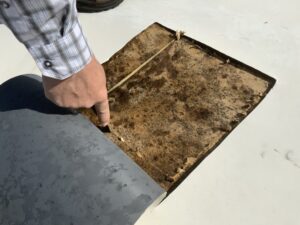
If insulation within the roof system becomes saturated — whether from a leak during construction or a failure years later — the warranty typically only covers what’s necessary to stop the leak. It does not require the manufacturer to replace wet insulation beneath the membrane.
Work by Other Trades After Installation
The moment an HVAC contractor, electrician, or anyone else accesses your roof and doesn’t follow warranty-approved procedures, you may have voided coverage in that area. Every rooftop unit installation, every conduit run, every visit by a maintenance crew creates a documentation requirement that most building owners never fulfill.
Sheet Metal Components
Flashings, copings, edge metal, scuppers, even when installed by the same roofing contractor, are frequently excluded from warranty coverage. This matters enormously because a significant portion of roof leaks originates at these transition points, not in the membrane field itself.
Ponding Water
Some manufacturers cover it, some don’t. Even among those who do, coverage may be limited. Ponding water that persists beyond 48 hours is generally considered a code violation, so a warranty that allows for ponding may put the owner in a difficult position relative to building code compliance.
Maintenance Requirements
Every commercial roof warranty requires documented, periodic maintenance by the owner. If you can’t produce maintenance records, the manufacturer has grounds to deny your claim. This provision is in every warranty, rarely explained to owners at the time of execution, and frequently forgotten.
The Salesperson, the Tech Rep, and the Legal Team
Here’s something Jeff Martin has observed in more than three decades of commercial roofing: a roof warranty means something different to each of the people involved in the transaction.
The manufacturer’s salesperson uses it as a selling tool, emphasizing length and coverage to win the bid. The technical representative cares primarily about whether the installation meets their specifications. The legal team that drafted the warranty document was focused on limiting the manufacturer’s liability.
When you read the warranty as a building owner, you’re reading the document the legal team wrote, not the sales conversation you had at the beginning of the project. Those two things can be very different.
We have seen manufacturer warranties with terms that exceed the amount of time the actual product has existed in the marketplace. Thirty-five-year warranties on materials that have only been commercially available for 15 or 20 years. Think about what that means from a practical standpoint.
Should You Even Bother Getting a Roof Warranty?
Yes. In the professional opinion of Fortress BEC, a manufacturer’s roof warranty is worth obtaining, but only if you understand what you’re actually buying and take steps to protect it.
Read the Warranty Before the Roof Goes On
Not after. Before. You need to understand what you’re agreeing to, what it excludes, and what obligations it places on you as the owner. If the language is complex, have an attorney review it. When you need a qualified roof consultant to help interpret the technical provisions, the International Institute of Building Enclosure Consultants (IIBEC) maintains a directory of credentialed professionals.
Get the Documents and Keep Them
This sounds absurdly simple. And yet Fortress BEC has worked with building owners who thought they had a warranty, needed to file a claim, and could not locate the paperwork. Make copies. Provide them to multiple people. If the warranty requires the owner’s signature before it’s executed, handle that immediately.
Document Every Rooftop Visit
Every visit by every trade. Who was up there, when, and what did they do? If a new piece of mechanical equipment is added, get written approval from the manufacturer before work begins, not after.
Perform and Document Routine Maintenance
This is a warranty requirement. A twice-yearly inspection by a qualified professional, with written documentation of findings and any corrective work, keeps your warranty in force and keeps small problems from becoming large ones.
The Real Goal Is Never Needing the Warranty
This is the point Jeff Martin always comes back to in his presentations to architects and building owners. The roof warranty is a safety net. Your goal should be to never need it.
That means starting with a proper design that reflects the owner’s actual performance requirements. It means quality materials installed by a contractor with real experience. It means inspections during the construction process, not just a manufacturer’s walkthrough after the roof is finished. And it means a maintenance program that treats the building envelope as the asset it is.
No roof system performs as intended by accident. It requires intentional decisions at every stage of the process. If you’re not sure whether your building’s roof was installed the way you paid for it, that’s a question worth answering before you need to file a claim.
What voids a commercial roof warranty?
Common warranty killers include undocumented or improperly approved work by other trades on the roof surface, failure to perform and document routine maintenance, use of non-approved materials or contractors for repairs, and ponding water in systems where it is listed as an exclusion. Any modification to the roof system after installation should be pre-approved in writing by the manufacturer before work begins.
Does a roof warranty cover water damage to the interior of a building?
In most cases, no. The vast majority of manufacturer roof warranties cover the cost to repair the leak and return the roof to a watertight condition. Consequential damages, meaning water damage to inventory, equipment, finishes, or lost business operations, are typically excluded. Owners who want coverage for consequential damages generally need to look to their property insurance policy, not the roof warranty.
How do I protect my roof warranty over the long term?
The most important steps are: document all rooftop access by any trade, perform and document routine maintenance at least twice a year, get written manufacturer approval before any post-installation modifications, and keep copies of all warranty documents in multiple locations. When in doubt, contact the manufacturer before allowing any work on the roof, not after.