A commercial roof inspection during construction is the single best way to make sure you actually get the roof you paid for. New roofs are routinely damaged by other trades, hold trapped moisture, fail to drain properly, or include sheet metal that does not meet code. This post covers what goes wrong, how a qualified third-party inspector finds it, and what owners should require before signing off.
After months of work, the owner takes delivery of their new building. The roof system is shiny, white, and under a manufacturer’s warranty. From the outside, everything looks right.
But are you really getting what you paid for?
That is exactly why a commercial roof inspection during construction matters. After more than three decades in commercial roofing and building envelope consulting, first as a contractor and then as a forensic consultant, Jeff Martin of Fortress Building Envelope Consulting has a direct answer: many times, you are not. Not because the roofing contractor was always negligent, but because a finished commercial roof is subjected to forces during construction that most owners never see and most final walkthroughs never catch.
Damage From Other Trades
The commercial roofing market is dominated by single-ply membranes. TPO, PVC, and EPDM systems all perform well when properly installed and protected. The problem is that a single-ply membrane is thinner and more vulnerable than the built-up assemblies it replaced.
On most projects, the roof goes on before the building is fully enclosed, because the structure has to be dried in to keep interior work moving. That means the finished membrane becomes a work platform for every other trade with work above the occupied floors. HVAC crews, electricians, plumbers, steel erectors. None of them is a roofer.
In the worst cases, they simply do not care. Fortress has documented damage ranging from minor scratches to holes cut through the membrane by workers who needed access to something below. One project had metal shavings deposited across the entire TPO surface from grinding work on the floors above. The hot shavings embedded into the sheet and oxidized, turning a white energy-reflective membrane the color of rust.
Every piece of mechanical equipment added after the roof is installed creates a new penetration. Every conduit run creates a new flashing condition. None of this is captured by the manufacturer’s final inspection, because it all happens after the inspector has signed off and the warranty is already issued. A commercial roof inspection during construction, performed by a qualified third party, is what catches these problems before they get buried.
Moisture Trapped During Construction
Water can enter a roof assembly during construction in ways that are difficult to detect and nearly impossible to correct once the roof is complete.
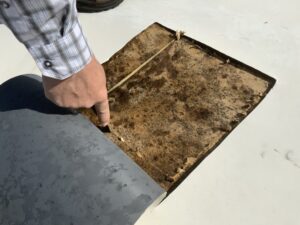
Insulation boards get rained on before installation. Daily tie-ins, the temporary seals at the edge of each day’s work, fail or are improperly made and let rain or dew in overnight. Improper sequencing leaves gaps in the assembly exposed to the weather. In each case, moisture gets covered up the next day without anyone knowing it was there.
What happens to that moisture depends on the assembly. A mechanically attached membrane over polyiso on a metal deck may eventually dry through air movement within the system. But a concrete deck with multiple layers of adhered insulation and an adhered membrane creates a sealed environment. That moisture stays. It reduces thermal performance, compromises adhesion, supports biological growth, and can create mystery leaks years later.
The frustrating reality is that this condition is almost never found by the architect, the manufacturer’s tech rep, or the owner at the final walkthrough. It looks fine from the surface. The only way to find it is through a commercial roof inspection during construction that includes the right testing.
Drainage That Doesn’t Drain
Code requires positive drainage on commercial roofs. In practice, it does not always happen.
Overflow scuppers get installed too high or in the wrong location. Roof drains get positioned without accounting for deck deflection. Crickets between drains are undersized to save money on insulation, leaving valleys where water pools.
Jeff has inspected large industrial facilities where crickets were shown on the architectural drawings but value-engineered out during construction, with the manufacturer’s blessing, because their warranty did not happen to exclude ponding water. The same project had sumps around every roof drain, specifically designed to encourage drainage. Eliminating the crickets made those sumps largely irrelevant.
Ponding water on a new roof is not a cosmetic issue. It cancels out any solar reflectivity value the membrane was specified to provide. It supports biological growth that further darkens the surface. On wood-deck construction, extended ponding adds load that causes deflection, which causes more ponding. And in any system, standing water makes leaks harder to find and easier to start.
Sheet Metal That Doesn’t Meet Code
Sheet metal is one of the most consistent sources of shortcuts.
The International Building Code, adopted in most jurisdictions across the United States, includes ES-1 provisions that govern copings, edge metal, and related components. These exist because wind uplift forces at the roof perimeter are significantly higher than in the field of the roof. An improperly fabricated or attached coping that fails in a storm can take large sections of membrane with it.
Common deficiencies include plywood or OSB substituted for the dimensional lumber required under copings, locking strips that are not the correct gauge or fastened at the required spacing, and counter flashings at wall conditions that allow thermal movement to open the top seal.
Scuppers are particularly vulnerable. A properly installed scupper has flanges on both interior and exterior sides, is flashed into the roof system on the roof side, and is sealed on the wall face. Because exterior scupper work requires access from a lift or scaffold that may no longer be on site, this work frequently gets done incompletely or skipped altogether. Water enters through the gap, migrates into both the roof assembly and the wall interior, and nobody notices until it shows up on a ceiling tile inside the building.
The Installation Instructions Nobody Reads
Here is one of the more striking observations from decades in the field. The manufacturer’s installation instructions are printed on the wrapper of every bundle of shingles sold in North America. They have been there for decades. Most installers have handled thousands of bundles.
Most have never read a word of them.
This is not unique to shingles. Single-ply manufacturers publish detailed installation guides, specification manuals, and technical bulletins. Sealant manufacturers list specific primer requirements and application conditions. Every component has installation requirements that affect how it performs.
When the answer to a question is, “I’ve been doing it this way for 25 years,” that is a signal worth paying attention to. Twenty-five years of doing something wrong does not make it right.
What You Can Do About It
Most of these problems are preventable with the right approach.
Peer review of construction documents by a qualified building envelope consultant, before the project goes to bid, can catch design details that will not translate to field installation. A pre-roofing conference that brings together the GC, roofing contractor, other trades, and the architect establishes expectations and sequences before work begins. A roof protection plan, in place before the membrane goes down, defines who protects the completed surface, how it gets monitored, and how repairs get handled.
And most importantly, testing. Electronic leak detection finds holes and voids invisible to the eye. Infrared thermal scanning identifies trapped moisture before it becomes a structural problem. Both should happen before close-out, before overburden goes on, and before warranty paperwork is signed.
The owner who commissions a qualified commercial roof inspection during construction, not just a manufacturer’s final walkthrough, is the one who actually gets what they paid for. Everyone else finds out what they got when the leaks start showing up.
Related Articles
- The Myth of the Roof Warranty: What Your Document Actually Covers
- Electronic Leak Detection Testing: What ELD Finds That Visual Inspections Miss
Frequently Asked Questions
What is a commercial roof inspection during construction, and who performs it?
A commercial roof inspection during construction is a series of evaluations performed while the roof is being installed, not just at the end. The most thorough version is performed by a qualified third-party building envelope consultant with credentials such as RRC or RRO from IIBEC. GCs and manufacturer reps also perform inspections, but they are inspecting their own work or only see the finished product. An independent consultant watching the work as it progresses catches problems that would otherwise be buried.
How common is roof damage from other trades during construction?
More common than most owners realize. Fortress has documented damage on commercial projects ranging from minor surface scratches to holes cut through single-ply membranes, punctures from dropped tools, and widespread membrane contamination from grinding operations on upper floors. On any project where the roof is installed before the building is fully enclosed, a written roof protection plan should be in place before the roofing contractor leaves the site.
What is electronic leak detection, and when should it be used?
Electronic leak detection (ELD) applies an electrical charge to a roof or waterproofing membrane, then scans the surface to identify defects that allow the current to pass through. It is particularly valuable when visual inspection is not enough or when the membrane has been exposed to construction traffic. For waterproofing systems under overburden such as pavers or growing media, ELD before overburden installation is one of the most cost-effective quality control steps available, and it pairs naturally with a commercial roof inspection during construction.