- Visible damage is not causation. Courts need a clear chain connecting a defect to a specific party and a specific failure.
- Forensic field tests produce measurable results. ELD, ASTM E1105, and AAMA 502.1 testing holds up in court in a way that visual descriptions do not.
- Documents and moisture mapping fill the gaps. Together they establish when the failure occurred, how far damage spread, and who is responsible.
- Objectivity is a credibility asset. Experts who work both plaintiff and defense are harder to shake on the stand.
Water stains on a ceiling. Mold behind drywall. Cracked caulk around a window.
Your client points to these and says something went wrong. They are right. But visible damage is the beginning of the argument, not the end of it.
Courts need causation. They need a clear chain: what failed, who is responsible, what they did wrong, and when. Without that chain, opposing counsel will offer other explanations. Moisture moves. Buildings settle. Many trades touched the building. Any one of them can raise enough doubt to weaken a strong case.
Here is how you build a chain that holds.
Why Visible Damage Will Not Win the Case
A water stain tells a judge that moisture got somewhere it should not be. It does not explain how. It does not name the source. It does not tell you whether a membrane was installed wrong, the wrong product was used, or another trade damaged a finished system after the fact.
Opposing counsel knows this. They will argue multiple possible causes, deferred maintenance, or that a different trade is responsible. Each argument creates doubt.
A forensic building envelope investigation eliminates that doubt. Not by taking a side. By finding the truth and documenting it in a way that survives cross-examination.
What a Forensic Investigation Gives You
A forensic investigation is not a walk-through with an opinion attached. It reconstructs what happened and produces documented, measurable evidence.
That starts with field testing. Electronic leak detection, or ELD, finds the exact location of a breach in a waterproofing membrane. ASTM E1105 testing floods windows and wall systems with controlled water pressure to find exactly where water is entering. AAMA 502.1 covers installed window and door systems.
These are not opinions. A test either passes or fails. That result is documented and reproducible. It holds up in court in a way that a visual description does not.
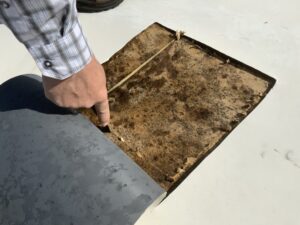
After field testing, the investigation goes deeper. Wall cavities are opened. Flashing details are examined. What was built is compared to what was specified. That comparison is often where causation becomes clear.
Why Your Expert’s Field Experience Matters
There is a real difference between an expert who has studied building systems and one who has installed them.
An investigator from the contracting side recognizes failure patterns that a purely academic expert might miss. A seam that looks fine in a photograph reads differently to someone who knows what correct installation looks and feels like.
That experience matters most under cross-examination. Defense counsel will ask about installation conditions, sequencing, and trade coordination. An expert who has spent decades installing the exact systems in dispute answers from direct experience. That is harder to attack than testimony built on theory.
What Moisture Mapping Shows the Court
Moisture mapping creates a visual record of where water entered and how far it traveled.
Infrared thermal imaging finds temperature differences in wall and roof systems that point to wet insulation or trapped moisture. Moisture meters confirm readings at specific locations. Together, they map how damage spread through the building.
That map does two things. It supports repair cost calculations by showing the true scope of damage. And it traces a path from entry point to harm, which directly supports your causation argument.
An early moisture map also sets a baseline. If conditions change, or the opposing party makes repairs before litigation ends, you have a documented record of what existed at a fixed point in time.
What the Document Trail Reveals
Buildings leave a paper record. Specifications, submittals, manufacturer installation requirements, RFIs, change orders, and inspection records all show what was required and what actually happened.
Document review is often where causation becomes provable.
An approved submittal shows what product was specified. The installation manual shows what it required. When field conditions do not match those records, or when records are missing, that gap is evidence.
Documents also establish timing. Materials substituted without approval. Inspections that were skipped. A trade sequence that left a system exposed too long. These facts shape the timeline, and the timeline shapes responsibility.
What a Strong Expert Report Must Do
An expert report is not a damage summary. It is a structured argument. It needs to answer four questions clearly enough to survive scrutiny.
What was observed. Facts backed by photos, test results, and measurements.
What the standard requires. The specification, manufacturer requirement, or code that governed the work.
Where the deviation occurred. How the installed work fell short of that standard.
What caused the damage. A supported opinion connecting the deviation to the failure, with alternative explanations addressed.
Every opinion should trace back to specific, documented evidence. If it cannot, opposing counsel will find the gap.
What Makes Testimony Hold Up
An expert report gets your case to the stand. Testimony is where it holds or falls apart.
The best testimony is direct and grounded in what was actually found. Experts who hedge or speak in generalities give opposing counsel room to work. Experts who can point to a specific test result, a specific document, and a specific location in the building are much harder to shake.
Credibility also comes from objectivity. An expert who works both plaintiff and defense is chosen because they find the truth, not because they say what you want to hear. Judges and juries notice that difference.
Learn more about how Fortress BEC approaches forensic investigations and what that process looks like from first contact to final report.
Ready to Talk Through Your Case?
If you have a construction defect case involving water intrusion, roofing, or building envelope failures, Fortress BEC offers a free case review. No obligation. Just an honest answer on whether we can help and what the investigation would look like.
Related Articles
- What a Construction Defect Expert Witness Costs (and Saves)
- Why Construction Defect Cases Are About to Surge And What Attorneys Need to Know Now
- Construction Defect Expert Witness: Why Contracting Experience Changes Everything
- Construction Defect Water Intrusion: Why It Drives 70% of Construction Lawsuits
Frequently Asked Questions
Why isn’t visible water damage enough to prove a construction defect case?
Visible damage shows that something failed. It does not show who is responsible, what caused it, or when it happened. Courts require causation. That means tracing the damage back to a specific defect in workmanship, materials, or design, backed by documented evidence.
What field tests produce the most defensible evidence?
Electronic leak detection finds membrane breaches. ASTM E1105 tests window and wall systems under controlled water pressure. AAMA 502.1 covers installed window and door systems. Each produces a documented pass or fail result that holds up far better under cross-examination than a visual assessment.
How does document review strengthen a causation argument?
Project documents show what was required and what actually happened. When installed work does not match specifications or manufacturer requirements, that gap is evidence. Missing records can be just as significant.
What should attorneys look for in a building envelope expert witness?
Look for someone with real field experience installing the systems in dispute. They should explain technical findings clearly, hold up under cross-examination, and work objectively on both sides. That objectivity is a credibility asset in front of a judge or jury.
When should a forensic investigation begin?
As early as possible. Conditions change, moisture spreads, and repairs can hide evidence of the original failure. Early investigation preserves a clear record that is critical for establishing causation and damages later in the case.